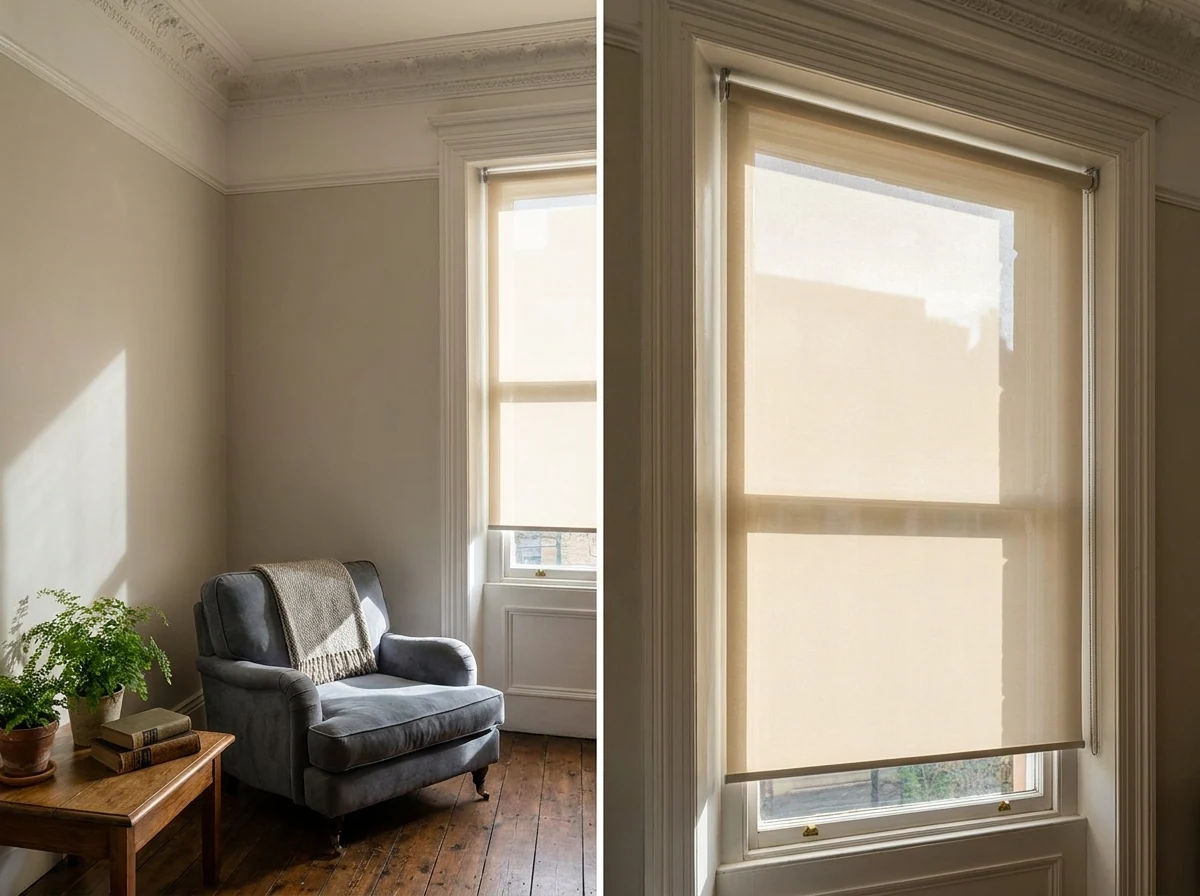
Stand in the bay of a Tamboerskloof terrace and look at the window itself for a moment. The opening is tall and narrow, the wall is a foot of old masonry, and the plastered reveal runs deep — deep enough to swallow a roller tube completely. That reveal is the whole story of fitting rollers here. The blind goes inside it, the century-old frame is never drilled, and the street sees nothing but glass.
It also settles the paperwork before it starts. Nothing fixes to the facade, so neither the National Heritage Resources Act nor the City Bowl's overlay zone has anything to say about it — and in a sectional-title block there is usually nothing for the trustees to approve either, because the outside of the building doesn't change.
Pick the room first. The fabric follows.
Bedrooms: first light in a Cape Town December arrives around half past five. A blockout roller, measured tight to the reveal, is the difference between waking with the sun and waking when you choose. Where the room also has a view worth keeping, a double roller carries blockout and sunscreen on one bracket — mesh by day, dark by night.
The west-facing lounge: this is the glass that punishes Tamboerskloof in February. The late sun comes in low and keeps dropping, so a 3% or 5% sunscreen mesh earns its keep — it strips the glare and most of the UV while the mountain stays visible through the weave. One honest caveat: after dark, with the lights on, that mesh works in reverse. Passers-by see in. Street-facing rooms get told this at the measure, not discovered later.
Kitchens and bathrooms: a light-filtering or coated fabric that wipes clean, on the shortest drop in the house. Nothing clever needed — just made to the millimetre.
What a proper sash measure involves
A hundred-year-old frame has usually moved. We measure the width of the reveal at the top, the middle and the sill, and make the blind to the narrowest of the three — that's the difference between a panel that glides and one that scrapes its guides every morning. Depth gets checked too: most reveals here take a slim cassette fully recessed; where an old box-sash pulley sits proud, an open roll on face brackets inside the opening does the same job.
- Width taken at three heights, blind made to the narrowest — old frames are rarely square.
- Cassette or open tube decided by reveal depth, not by catalogue default.
- Chain side chosen for reach, clear of the sash latch and curtain returns.
- Chain tensioners fitted as standard; cordless or motorised recommended wherever small children sleep.
When to skip the chain altogether
Plenty of houses on these slopes have a stair landing or double-volume window nobody can reach without a ladder. A battery motor inside the tube solves it — charged twice a year, driven from a remote or a wall switch, no wiring chased into old plaster. It's a modest step up in cost and we'll quote it alongside the chain version so the difference is plain.
We measure and fit roller blinds across Tamboerskloof and the rest of the City Bowl — Oranjezicht, Higgovale, Gardens and Vredehoek.
A bracket rather than a quotation, worked by the square metre installed. Chain or spring rollers in blockout, sunscreen or a light-filtering weave price at R1,000 to R1,600 — plain blockout cheapest, and a low-openness sunscreen on a window that keeps the mountain, or a double roller running two fabrics off one head, dearest. With a battery motor in the tube, budget R2,500 to R3,800.
Sash windows have one predictable effect: they are tall and narrow rather than wide, and they come in numbers. A narrow opening costs more per square metre than a broad one, since bracket, tube and labour do not shrink with the width, so anything tiny attracts a minimum. That is why the quote lists each window separately. The real figure follows the free measure, in writing.